Science Summary: Heart Rate Recovery is an indicator of the autonomous functioning of the heart, and it results in the withdrawal of the so-called sympathetic activity and the reactivation of the parasympathetic nervous activity. The latter is responsible for the ability to…
Science Summary:
Heart Rate Recovery is an indicator of the autonomous functioning of the heart, and it results in the withdrawal of the so-called sympathetic activity and the reactivation of the parasympathetic nervous activity.
The latter is responsible for the ability to…
Sources
3. Sleep Get enough (7-8 hours) of high-quality night sleep to allow for full recovery in support of your exercise goals. + Keep Regular Sleep schedule + Have an effective wind-down routine for maximal recovery.
3. Sleep
Get enough (7-8 hours) of high-quality night sleep to allow for full recovery in support of your exercise goals.
+ Keep Regular Sleep schedule + Have an effective wind-down routine for maximal recovery.
4. Additional considerations: + Hydration + Exogenous ketones can help boost your performance + Limit processed foods + Limit caffeine
4. Additional considerations:
+ Hydration + Exogenous ketones can help boost your performance + Limit processed foods + Limit caffeine
What does poor HRR indicate? Increased all-cause mortality and heart attack risk. Low HRR can be associated to one or more of the following: Coronary Artery Disease Heart Failure Hypertension Metabolic Syndrome Diabetes Sleep Apnea In a landmark NEJM study with over 2000…
What does poor HRR indicate?
Increased all-cause mortality and heart attack risk.
Low HRR can be associated to one or more of the following:
Coronary Artery Disease Heart Failure Hypertension Metabolic Syndrome Diabetes Sleep Apnea
In a landmark NEJM study with over 2000…
Here’s how you can improve your HRR: 1. Exercise: Aim for at least 150 minutes of moderate-intensity or 75 minutes of vigorous-intensity aerobic exercise per week
Here’s how you can improve your HRR:
1. Exercise:
Aim for at least 150 minutes of moderate-intensity or 75 minutes of vigorous-intensity aerobic exercise per week
2. Diet Focus on foods for cardiac health, including healthy fats: omega3 from nuts, fish and supplements, in addition to extra virgin olive oil (EVOO). Polyphenols from EVOO, berries and dark chocolate support recovery due to their anti-inflammatory and antioxidant properties.…
2. Diet
Focus on foods for cardiac health, including healthy fats: omega3 from nuts, fish and supplements, in addition to extra virgin olive oil (EVOO).
Polyphenols from EVOO, berries and dark chocolate support recovery due to their anti-inflammatory and antioxidant properties.…
Here's how to Measure your (HRR) 1. Exercise vigorously 2. Record peak heart rate 3. Rest 1 minute 4. Record heart rate again 5. Subtract second reading from peak Result is your 1-minute HRR in bpm.
Here's how to Measure your (HRR)
1. Exercise vigorously 2. Record peak heart rate 3. Rest 1 minute 4. Record heart rate again 5. Subtract second reading from peak
Result is your 1-minute HRR in bpm.
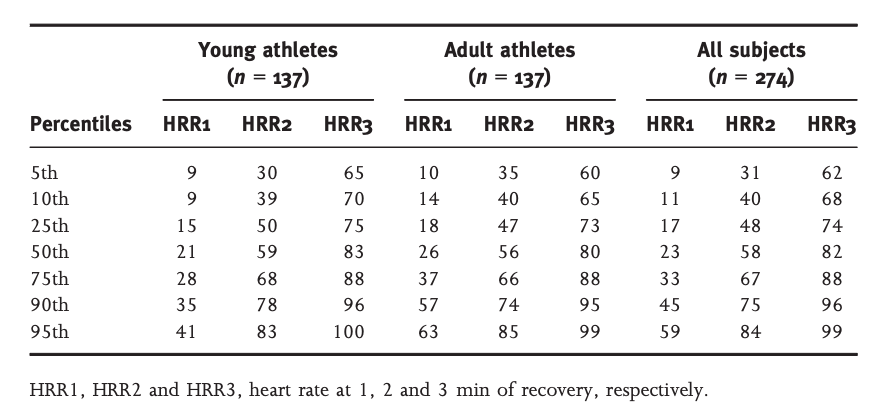
Compare Yourself to Elite Athletes and the General Population with These Graphs: a. Two cohorts of young and adult elite athlete males. b. A general population cohort of regular active adult males
Compare Yourself to Elite Athletes and the General Population with These Graphs:
a. Two cohorts of young and adult elite athlete males. b. A general population cohort of regular active adult males
Sadly, reliable numbers are lacking for fit females per age group. The unavailability of such HRR numbers per age group for healthy and fit women is a sign that disparities in representation in clinical literature -if declining- still exist. We will soon take action with the…
Sadly, reliable numbers are lacking for fit females per age group.
The unavailability of such HRR numbers per age group for healthy and fit women is a sign that disparities in representation in clinical literature -if declining- still exist.
We will soon take action with the…